Vietnam Veterans Sue to Block Trump’s 250-Foot Arch at Arlington, Citing Disrupted Historic Views

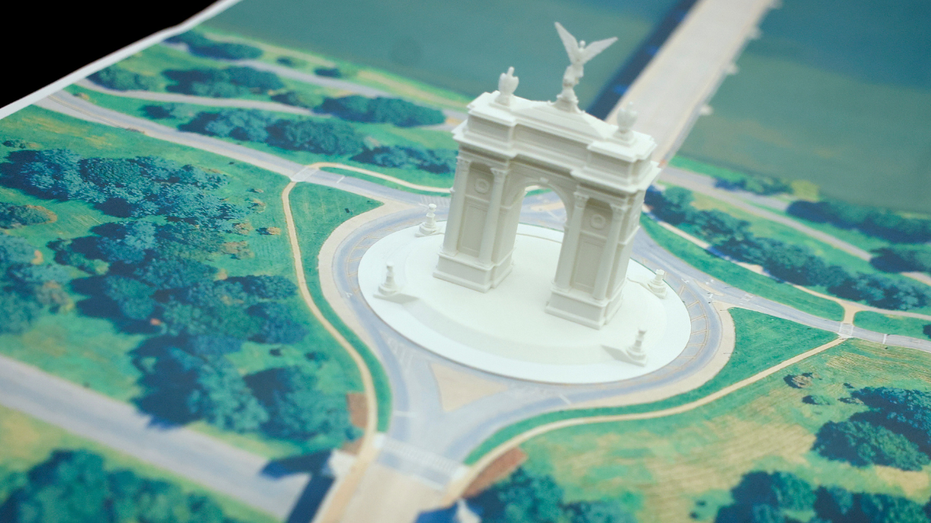
Three Vietnam veterans and an architectural historian are challenging President Donald Trump’s plan to erect a 250-foot triumphal arch at Memorial Circle in Washington, D.C., arguing that the structure would obstruct some of the capital’s most iconic views and has not received proper congressional approval.
The plaintiffs—Michael Lemmon, Shaun Byrnes, and Jon Gundersen, along with architectural historian Calder Loth—have been engaged in a months-long legal battle over the project, which Trump has described as the largest arch in the world.
The Dispute Over Historic Sightlines
At the center of the case is the arch’s potential impact on the uninterrupted view between the Lincoln Memorial on the east side of the Potomac River and Arlington House, the Robert E. Lee Memorial, on the west side within Arlington National Cemetery.
Nicolas Sansone, an attorney with the Public Citizen Litigation Group representing the plaintiffs, told Fox News Digital that the capital was deliberately designed to preserve such vistas.
“One of the sort of central design features is that the capital has been laid out in a very deliberate way to create this uninterrupted view between the Lincoln Memorial on the east side of the Potomac River and Arlington House, the Robert E. Lee Memorial, on the west side in Arlington National Cemetery,” Sansone said.
He added that the plaintiffs are concerned about the impact the enormous structure would have on that historic symbolic view, which each of them finds deeply meaningful.
Two of the veteran plaintiffs hope to be buried at Arlington National Cemetery, according to Sansone, and all four plaintiffs have a deep personal relationship with the cemetery.
Adverse Effects Acknowledged in Planning Document
Critics contend the planned arch is disrespectful to the solemn character of the cemetery, which serves as the final resting place for more than 400,000 military service members.
The Trump administration itself acknowledged in a planning document that the project would have “adverse effects on historic properties.”
“Such adverse effects cannot be fully avoided while retaining the location-dependent purpose of the undertaking,” the National Park Service wrote in the document.
Legal Challenge and Congressional Authorization
Earlier this month, the administration announced that excavation work for the project would begin within the next two weeks.
The plaintiffs have asked a federal judge to issue a temporary restraining order to halt the project, arguing that it cannot be built without authorization from Congress.
The Trump administration has cited a 1925 law that originally authorized a pair of 166-foot columns in Washington, D.C., that were never built. Administration officials argue that past congressional approval grandfathers the triumphal arch project and allows them to avoid seeking new authorization from Congress.
Sansone disputed that reasoning, framing the case as a fundamental question about who has the authority to decide the fate of national monuments.
“The idea is that really it’s just an institutional question of who gets to decide: Is it one person, the person sitting in the White House, or should it be a sort of democratic deliberative process to sort of figure out what these monuments should look like, where they should be situated, what they should commemorate, and the like,” he said.
He further argued that the 1925 authorization cannot reasonably be stretched to cover a completely different project.
“Congress’s authorization to have a particular project built at a particular time subject to a specific price cap by a now-disbanded commission can’t reasonably be relied on to authorize a totally different independent project that’s going to cost way more money centuries into the future,” Sansone said.